
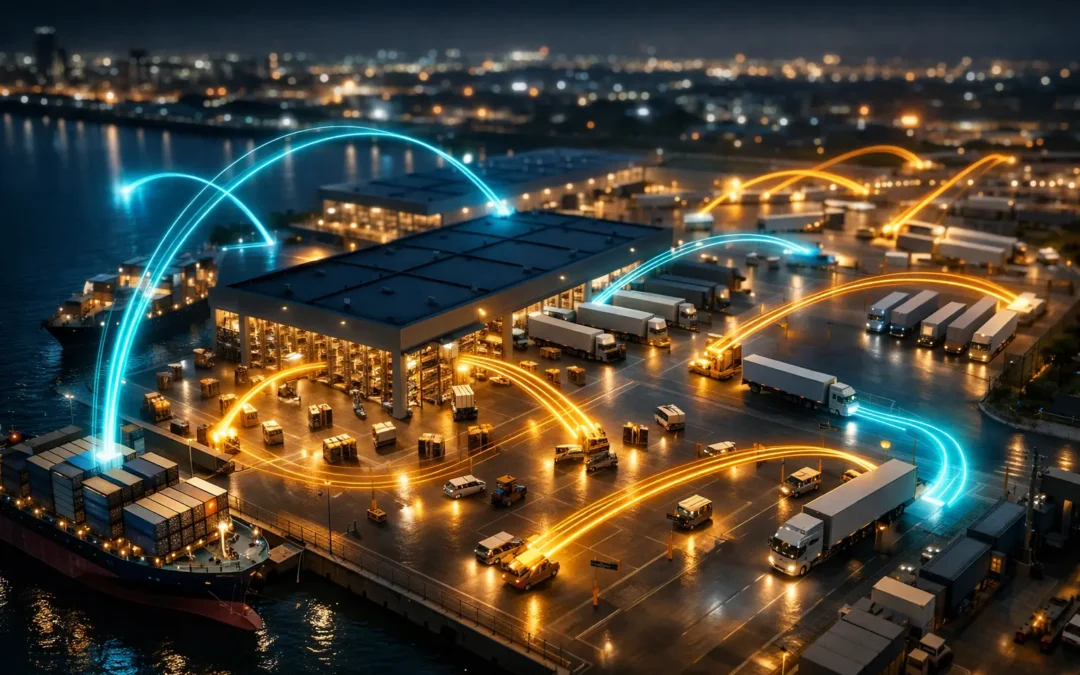
In the complex logistics environment, efficiency is no longer measured solely by delivery capacity, but by the capacity for anticipation. Global supply chains are subject to constant volatility, from sudden geopolitical changes to extreme weather events. In this scenario, relying on static planning systems is an unacceptable financial risk. The integration of predictive models and autonomous agents is transforming logistics from a reactive function into a proactive resilience engine that directly protects commercial margins.
Overcoming Operational Blindness with Predictive Models
Traditionally, supply chain management was based on historical data: what we sold last year defines what we order today. However, the past is no longer a reliable predictor of the future. New generation predictive models analyse thousands of external variables in real time, such as global maritime traffic, fluctuations in fuel prices and emerging consumer trends on social media.
This technical capability allows for the identification of bottlenecks before they physically manifest. If the system detects an imminent delay at a key port, it does not wait for the container to fail to arrive; it automatically recalculates delivery dates and suggests alternatives long before the problem affects production or the final customer.
The Role of Autonomous Agents in Decision Making
The real revolution is not just knowing that something is going to fail but having the capacity to act without constant human intervention. This is where autonomous agents come into play. Unlike traditional software, an agent has a mission: to ensure that stock is maintained at optimal levels at the lowest possible cost.
When a predictive agent identifies a risk, operational agents can execute immediate actions:
- Dynamic Rerouting: If a habitual route is blocked or becomes more expensive, the agent can automatically negotiate and contract space on alternative routes, comparing costs and times in seconds.
- Intelligent Inventory Adjustment: The system can autonomously decide to reduce the safety stock of a product that is losing traction and increase that of another showing signs of imminent high demand, optimizing working capital.
- Proactive Communication with the Ecosystem: Agents do not only act internally; they can inform suppliers and carriers about changes in demand, aligning the entire value chain without the need for endless email threads.
Protecting Commercial Margins Against the Unforeseen
The impact of these technologies on the P&L is direct. Stock-outs mean lost sales, while excess inventory means storage costs and the risk of obsolescence. A well-integrated AI architecture acts as a financial buffer.
Real-time resilience means the company is no longer a victim of global circumstances but has the agility necessary to manoeuvre through them. By minimizing stock-outs and optimizing transport routes, extraordinary logistics costs that usually devour net profit during times of crisis are reduced.
Logistics as a Strategic Competitive Advantage
Logistics has ceased to be a cost centre to become a competitive advantage. A company that can guarantee its deliveries while its competitors suffer delays not only protects its margin but also gains market share.
The industrial maturity of AI is demonstrated here: in the ability to connect the physical world with digital reasoning to create operations that are, by design, resistant to chaos. Technology does not just make the supply chain faster; it makes it smarter and, above all, much more profitable.
Is your supply chain designed to react to problems or to anticipate them? We help organizations implement logistical AI solutions that transform uncertainty into a business opportunity: