
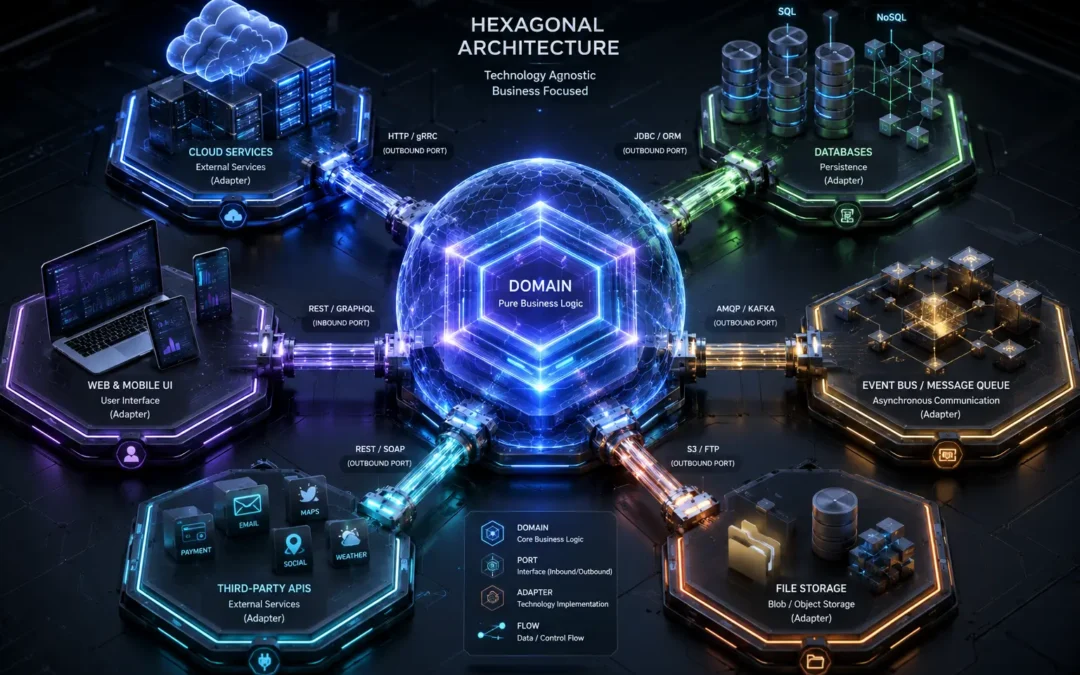
The bidirectional dependency between business logic and infrastructure is the primary catalyst for technical debt in enterprise systems. Hexagonal Architecture (Ports and Adapters) introduces a strict risk-mitigation paradigm: the Domain governs through contracts and the Infrastructure conforms to them.
The objective of this topology is to ensure an Application Core that is completely independent of frameworks, persistence engines, UI delivery channels or cloud platforms.
Advanced Anatomy: Integration with Domain-Driven Design (DDD)
The hexagonal pattern reaches its full potential when the interior of the hexagon is modelled using Domain-Driven Design principles. The structure is divided into layers of progressive isolation, rigorously applying the Dependency Inversion Principle (DIP).
1. The Core: Domain Model & Application Services
This area is strictly isolated. It has no knowledge of HTTP protocols, SQL or external libraries.
- Domain Entities & Value Objects: Immutable structures or objects with encapsulated state that enforce the core business rules.
- Aggregates: Clusters of entities treated as a single transactional modification unit.
- Use Cases (Application Services): Orchestrators that receive commands from external sources, interact with the Domain Model and coordinate outputs.
2. The Boundary: Ports (Contracts)
These are the communication interfaces that the Application Core exposes or requires.
- Driving Ports (Inbound): Interfaces that define the available Use Cases. They specify what the system can do (e.g., ProcessPaymentUseCase).
- Driven Ports (Outbound): Interfaces defined by the domain to interact with external systems without knowing their implementation. They specify what the system needs (e.g., PaymentGatewayPort, CustomerRepositoryPort).
3. The Periphery: Adapters (Infrastructure)
Concrete technological implementations that connect the physical world to the ports.
- Driving Adapters (Input): Transform external stimuli into calls to Driving Ports (e.g., REST API Controllers, gRPC Endpoints, AWS Lambda Handlers, Kafka Consumers).
- Driven Adapters (Output): Implement the Driven Ports to interact with external services (e.g., PostgreSQL Repositories, MongoDB Mappers, S3 Storage Clients, Stripe API Clients).
Architectural Diagram: Bidirectional Flow of DTOs and Domain Objects
In enterprise architectures, entity isolation is critical. External systems communicate through Data Transfer Objects (DTOs), protecting business rules from accidental modifications.
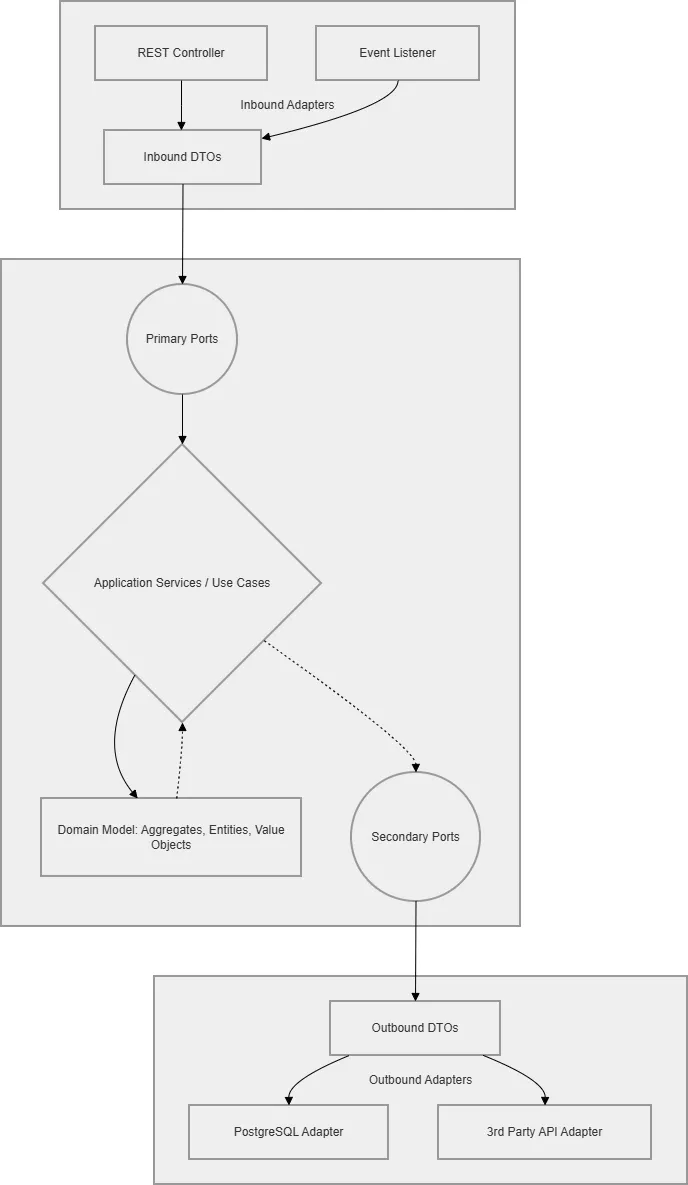
Data Mapping Strategie
The cost of this level of isolation is the need to map objects between layers. There are three primary approaches:
- Two-Way Mapping: Each layer has its own model (Web Model → Domain Model → Data Model).
- Strategic Assessment: Provides the highest level of isolation. It is ideal for complex domains and long-lived architectures, although its implementation requires greater development effort.
- One-Way Mapping: Interfaces use Domain Entities as return objects, while receiving dedicated command objects for data input.
- Strategic Assessment: Offers an excellent balance, particularly valuable in read-intensive services (CQRS).
- No Mapping (Anti-Pattern): The Database Entity is exposed directly from the data layer all the way up to the Controllers.
- Strategic Assessment: Accelerates time-to-market and can be viable for MVPs or simple CRUD applications, but it violates hexagonal isolation principles and becomes a major source of technical debt as the ecosystem grows.
Architectural Comparison: Hexagonal vs. Model-View-Controller (MVC)
A common misconception among engineering teams is attempting to map Hexagonal Architecture directly onto the traditional Model-View-Controller (MVC) pattern. It is essential to understand that they address design concerns at fundamentally different levels of abstraction.
While MVC is primarily a presentation-oriented pattern designed for user interfaces in monolithic environments, Hexagonal Architecture governs the dependency topology of the entire ecosystem.
The Structural Limitation of MVC in Enterprise Environments
The standard flow of an MVC framework often introduces undesirable database-centric coupling (Data-Driven Architecture):
- The Controller receives the request.
- It directly invokes the Model (often acting as a SQL-coupled persistence model).
- It returns data to be rendered by the View.
This design creates friction as systems scale: replacing the database engine or exposing the same business logic through gRPC or GraphQL often requires significant modifications to both Models and Controllers.
The Hexagonal Resolution to the MVC Trap
Hexagonal Architecture absorbs the MVC pattern and confines it strictly to the system’s periphery, treating it as nothing more than an input adapter.
- Primary Focus: While MVC concentrates on the structure of web or API presentation, Hexagonal Architecture enforces strict isolation of business logic.
- Dependency Direction: In MVC, the flow is inherently top-down (UI → Logic → Database). In the Hexagonal pattern, all dependencies point inward (Infrastructure → Ports → Domain).
- Role of the Database: MVC typically prioritizes persistence, with design often starting from the database schema. In the Hexagonal approach, the database is merely a peripheral implementation detail.
- Technological Evolution: Replacing a persistence framework in an MVC architecture introduces significant structural friction. In Hexagonal Architecture, the friction is minimal, since frameworks and databases can be replaced without impacting the application’s core.
Strategic Impact on the Testing Pyramid
The economic justification (ROI) for isolating the Business Core becomes evident through the dramatic reduction of execution time in CI/CD pipelines.
1. Core Unit Testing (Fast & Deterministic)
Approximately 80% of tests focus on the Domain layer. Since there are no network dependencies, these tests execute in milliseconds, using Test Doubles to simulate Driven Ports.
2. Adapter Integration Testing
Approximately 15% of tests validate that Driven Adapters communicate correctly with real infrastructure, typically using Testcontainers to provision ephemeral databases.
3. End-to-End Testing (E2E)
Only 5% of tests are allocated to expensive full-system validation scenarios.
Advanced Use Cases
Scenario A: Evolution Toward Serverless Ecosystems
A corporation operates a system built with NestJS exposing a REST API. A new requirement emerges for large-scale asynchronous cloud processing. Thanks to the hexagonal architecture pattern, the team keeps the entire Application Core unchanged. They simply build a new AWS Lambda Adapter that invokes the same Driving Port. Regression risk remains close to zero.
Scenario B: Polyglot Persistence Strategy
A system requires strong consistency (ACID) for payments while also supporting high-performance fuzzy searches for product catalogs. The architecture defines two Driven Ports: TransactionPort and SearchPort.
The first is implemented through a PostgreSQL Adapter, while the second is implemented through an Elasticsearch Adapter. The Use Case orchestrates both operations without any knowledge of the underlying technologies.
Architectural Verdict
Implementing Hexagonal Architecture is not a trivial decision. It requires a steep learning curve, disciplined responsibility segregation and unwavering architectural rigor.
However, for core products such as Enterprise Applications and long-term SaaS platforms, it remains the gold standard for ensuring that business models can outlive the inevitable obsolescence of frameworks and technology stacks.